
WELCOME TO HELL.
Hell is a room with no mirrors, no windows, and no way to mark the passage of time. Nothing to look at but one another, nowhere to hide, and no escape from the eyes that follow your every move.
In Martine Dominique Olan’s (5 BFA Theater Arts) student thesis production of Jean-Paul Sartre’s No Exit (1944), hell is more than the place where the dead are condemned to suffer. It is where the damned lose the power to define themselves, left at the mercy of others’ perceptions and unable to reconcile who they believe themselves to be with how others see them.
The play follows three strangers doomed to share a room for eternity: Vincent Cradeau (Ethan Wong), a journalist desperate to defend his own morality; Estelle Delaunay (Lee Delos Santos), a woman who seeks others’ desire to affirm her worth; and Inez Serrano (Claudia Enriquez), who sees through the other two’s pretenses even as she attempts to bend them to her will. As the unholy trinity’s secrets begin to unravel, all three try to preserve their carefully constructed self-images by tearing down the others, becoming both judge and executioner in a hell of their own making.
Staged at the Ateneo de Manila University’s Fine Arts Blackbox Theater last October 23–26, the production drew its audience into this unsettling arrangement. Spectators sat around the playing space, silent witnesses to the ensemble’s scrutiny and torment of one another. Yet the audience, too, was implicated in the act of looking. The characters may be trapped in the room, but the spectators were free to leave; even so, they remained to watch.

Estelle (left), Inez (middle), and Cradeau (right). Photo courtesy of Ysabel Aunor.
HELL—IS OTHER PEOPLE!
Who are you when others are watching? For Olan, this question lay at the heart of No Exit.
“There’s nobody else [but them] in the room, yet the idea of the gaze, of being perceived, is so persistent,” she explained.
Her interpretation centered on the gaze: the power of being seen by another person, and of having one’s identity shaped by that person’s perception. The characters themselves cannot control how they appear to one another, yet each remains desperate to dictate that perception.
The cast brought all these dialectical contradictions to life, portraying characters whose flaws were as striking as their more sympathetic qualities. Yet, just as one exposes the other’s secrets, the actors reveal the insecurities beneath their character’s bravado.
No single performance overshadowed the others. Wong’s portrayal of Cradeau captured the character’s self-righteousness as a principled journalist, despite the cowardice and male chauvinism that undermine his convictions. His thunderous voice and ferocious physicality brought Cradeau’s aggression to the surface while at the same time preserving his vulnerability, signalling the fragility of the moral image he struggles to defend.
As Estelle, Delos Santos adopted the polished mannerisms of a high-society woman accustomed to admiration, shifting between helpless desperation and poised, devious elegance. Similarly, Enriquez’s Inez was sardonic and confrontational, delivering her cruel observations with such sharpness that she was as grating as she was compelling.
Despite his limited stage time, Joaquin Delos Santos also left a memorable impression as the Boy, whose sinister smile and unhurried movements lent the attendant of Hell an unsettling air of mystery. Together, the cast sustained the uneasy dynamic at the heart of the play, making each character’s need for validation—and their capacity for torment—feel ever so painfully human.
SETTLING DOWN IN HELL
The empty, almost pitiful atmosphere of Hell wouldn’t be complete without the efforts of the production team who worked tirelessly alongside the cast to shape it into something reflective of the characters’ dispositions and flaws.
No detail escaped the eyes of Set Designer Julia Macuja, as the entirety of the theatre was utilized to its fullest extent. Door frames and peering eyes decorated the ceilings and walls, adding a layer of entrapment that implicates the audience as subjected to the gaze. To the characters, these pieces are an affirmation of both their guilt and their powerlessness to change people’s perceptions of them post-mortem.
The very doors that confined the theatre were also opened up during the final act of the play, subverting expectations on the limitations of the set and symbolizing how the only thing holding back the characters’ escape is their need to appeal to the others’ scrutinizing perception of them. This choice ends up revealing the presence of the audience to the condemned trio, leaving them to frantically demand that they not look upon their actions.
The team’s meticulousness also extended towards their wardrobe by Costume Designer Domenique Oligane. Each character’s choice of wear not only did justice to the type of people they were but also greatly helped in being immersed in the play’s 20th-century setting. For instance, Cradeau’s brown jacket and tie indicate his position as a news reporter, while Estelle’s multi-paletted headscarf and pink purse expose her position as an upper-class woman.
This decision added flair to the performance, painting the cast as ordinary people up until the mask slipped away. These costumes also served a narrative purpose outside of just being clothing, with Cradeau and Estelle’s undressing signifying their attempt to have intimacy—one that would fall apart due to Cradeau’s own inability to escape Inez’s derisive gaze.
The play also used deliberate lighting techniques like honing in on individual characters to emphasize mood and character development, all while sprinkling in sound effects during dialogue with intense imagery to explore how one character can be too caught up in their own stories and biases to actually care about the other two. Viggo Demonteverde and the rest of the lights crew chose striking hues and positions that made every shift in tone in the play even more impactful. Blue lights drenched the floor during character monologues, giving an air of sympathy towards them, while red lights flickered intensely when their true colors emerged.
On the other hand, Zak Capindig and his sounds team succeeded in bringing power to the little moments in the play using their carefully chosen selection of sounds. Sound effects like trains running during Cradeau’s reflections and waves crashing against the shore during Estelle’s confession of murder worked to keep audience engagement without distracting from the cast.
A HELL OF OUR OWN MAKING.
“This is the dwelling of the devil, and you’re in it!” the Boy declares.
Yet for Olan, No Exit is as much about the hell we make for ourselves as it is about the suffering others inflict on us. Cradeau, Estelle, and Inez all look to someone else to validate their identities, giving others the power to inflict the very suffering they fear. Their suffering grows dark and ugly as they become trapped in an endless cycle of constantly seeking approval from the very people who torment them.
Sartre’s famous line, “Hell is other people!” takes on renewed significance in Olan’s interpretation. Her decision to stage No Exit was partly driven by its relevance to contemporary experiences of scrutiny within the realm of social media and cancel culture. The play’s exploration of how others’ perceptions shape one’s identity resonates soundly in a world where a person’s actions can circulate online long after the moment has passed, shaping public opinion beyond their original contexts.
Much like the characters in Sartre’s room, people online can often find themselves unable to escape the judgements of others. The characters cannot escape one another’s gaze, even as their backs are turned towards each other. Online, posts and comments remain; judgements outlast the moment that prompted them. The gaze, it seems, is eternal.
As audiences leave the theater, Olan hopes they will reflect on how these pressures play out in their own lives. She wants people to start “owning themselves,” to “stop letting other people define who they are,” and to recognize their own self-worth and dignity. Although one cannot always control how others perceive them, they can choose how much power those perceptions hold over their sense of self. Olan’s interpretation invites the audience to question just how far their identities have come to depend on others’ approval.
As Inez warns, “You are your lie and nothing else.” In letting others define who we are, we risk losing sight of ourselves and thus living through a hell of our own making.
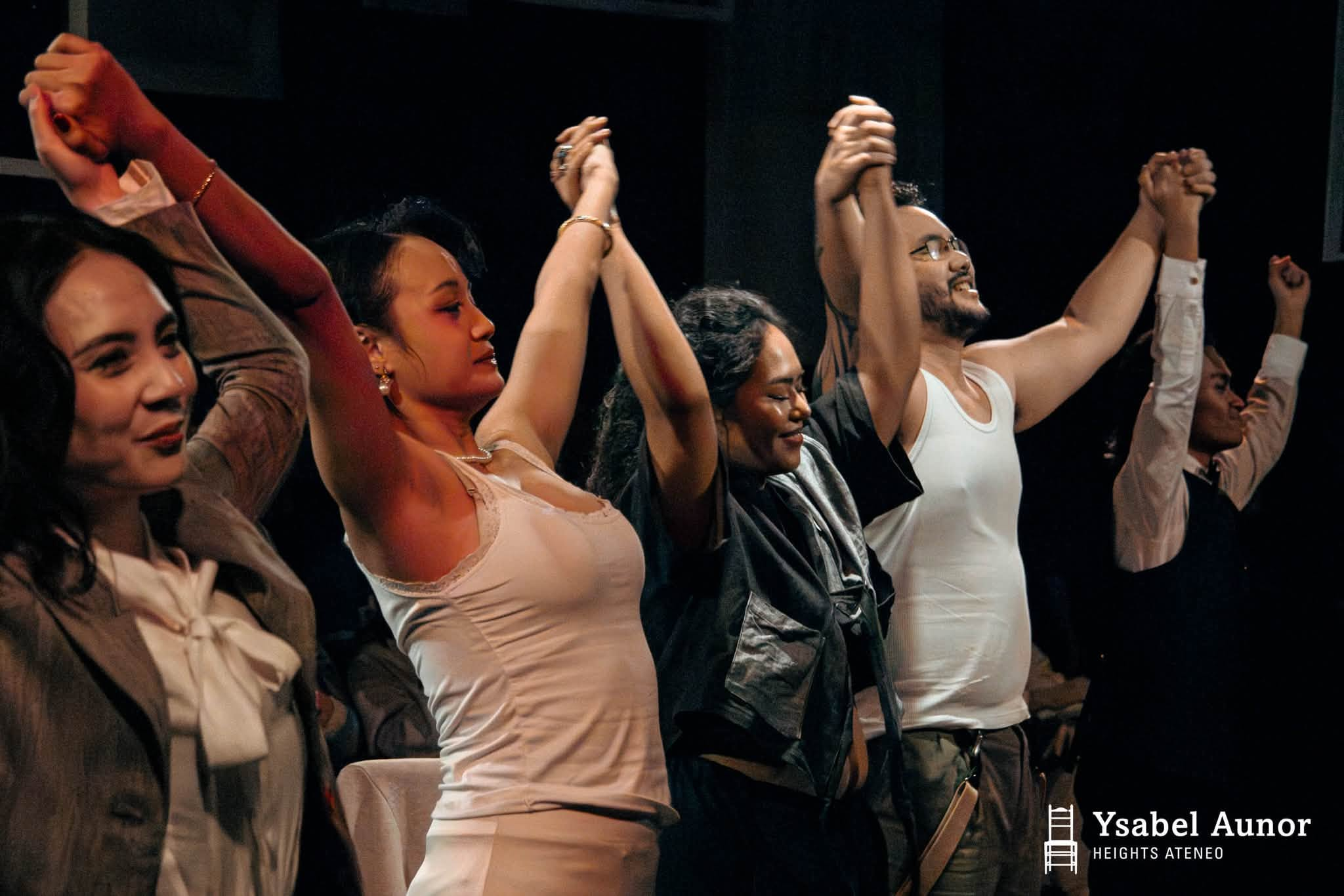
Photo courtesy of Ysabel Aunor
Shine Cabantog is a multimedia artist completing a BFA in Information Design at the Ateneo de Manila University. She lives and breathes art, allowing it to permeate her soul. For more of her works, catch her on her Instagram @sa.silangan.
Ryan Menchate is a literature student who thrives in the unassuming intersection between dichotomies in his life: English-leaning yet Filipino, jazz-oriented yet classically trained, silly yet solemn. Using a plethora of literary lessons as a framework, he writes for the memory of the media that deserve one. More than anything, Ryan hopes to give form to the ridiculous but often worthwhile aspect of our lives.
We are calling for contributions for the next set of articles to be featured right in our next folio. Come and submit your works today!


