
At least, she is in The Playbook Club’s all-female production of A Midsummer Night’s Dream. Yet the audience does not need much convincing: she is still Demetrius—Shakespeare’s arrogant Athenian suitor, even when played by a woman.
Shakespearean plays like A Midsummer Night’s Dream always see gender and power as inseparable. Hermia’s sovereignty of choice in marriage is conditional to her father’s authority and Athenian law; Hippolyta enters her marriage to Theseus after he has conquered her as an Amazon warrior queen; and even in the enchanted forest, Oberon uses magic to manipulate Titania’s desires.
The Playbook Club’s staging of A Midsummer Night’s Dream into an all-female cast is not merely a casting curiosité, but a reckoning of masculinity at its metaphysical and phenomenological core: what does it mean to be horny, lust-drunken men—and what changes when women embody them?
The play’s bare bones
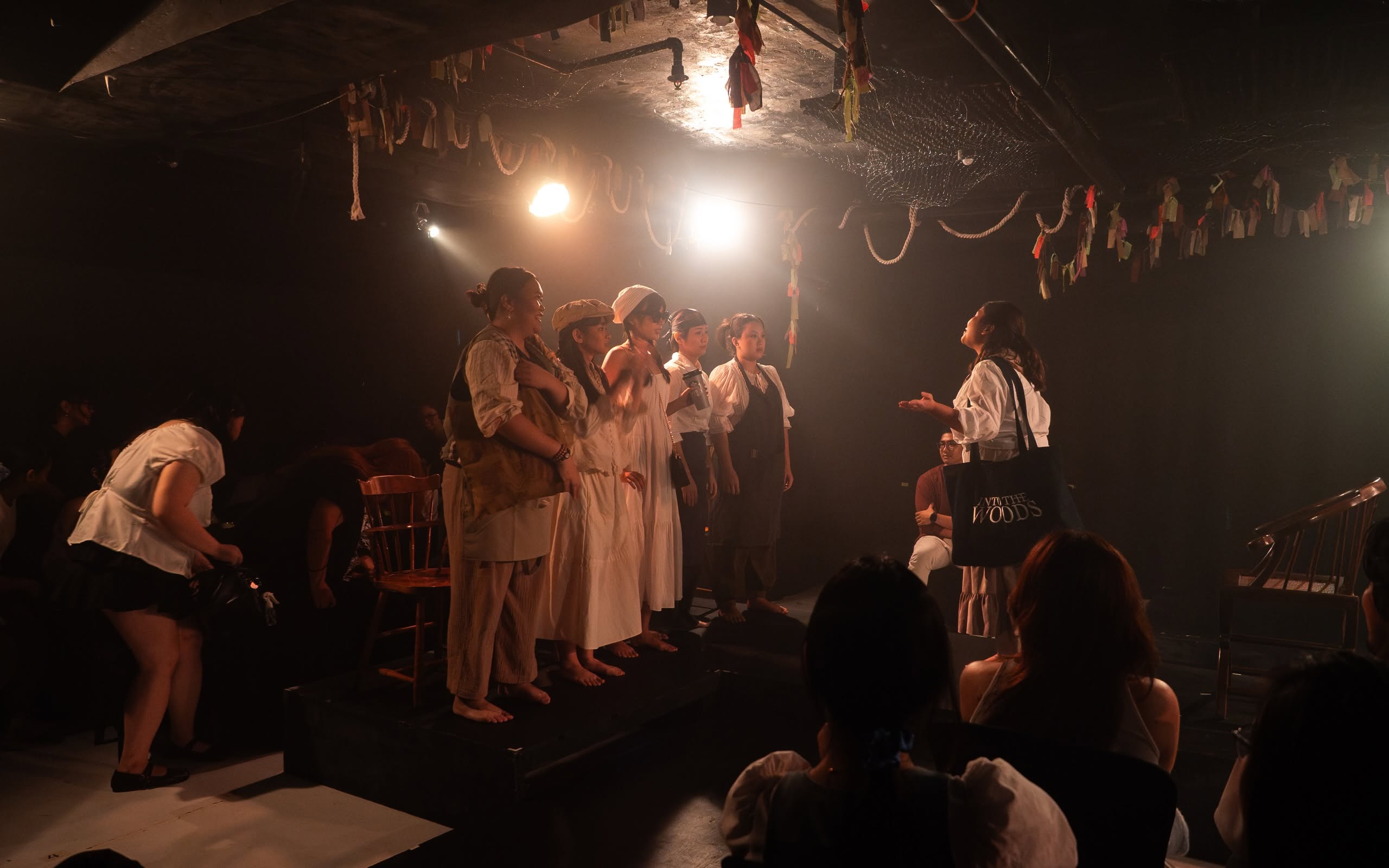
At its barest, The Playbook Club’s production is an anachronistic, singular act stripped entirely of the Athenian setting expected from A Midsummer Night’s Dream. Contemporary music and jarring, colorful lighting blend with Shakespearean language and slips of contemporary speech registers.
In the press preview, the cast described the production as an attempt to democratize Shakespeare for audiences beyond avid readers of classical literature. Yet, particularly in the first half, its dialogue remains largely faithful to Shakespearean language. While the production’s contemporary staging and physical comedy make the play visually accessible, the persistence of Shakespearean diction can at times feel at odds with its stated aim of accessibility.
Consequently, this lands as a deliberate indifference in locating A Midsummer Night’s Dream firmly within Shakespeare’s world. Its largely uniform use of colorful lighting and minimal set changes creates the illusion of everything occurring within a single continuous space, as fairy lights and draped cloth lend the stage a distinctly bohemian quality. The space of whimsicality, gorgeously vitalized by production designer Sarah Facuri, echoes the Pickwick Club from Louisa May Alcott’s Little Women (coincidentally the spiritual inspiration for The Playbook Club itself), a literary secret society where the central sisters dress as male personas and cultivate a space for their voices amidst the patriarchal outside world. Sound familiar?
Contemporary music and frequent fourth-wall breaks further collapse the distance between Shakespeare’s text and its present-day audience. The occasional singing of Justin Bieber’s “Beauty and the Beat” throughout the play is an appreciable garnish that unexpectedly injects humor into the production. There are even orchestrated instances of audience participation: actors directly interact with or direct their lines to the house, and in one particular case, members of the audience at one end of the stage were asked to stand to better see the ongoing action.
The effect is inviting, but comes at a cost. The production often felt closer to a contemporary comedy showcase borrowing Shakespeare’s text, rather than being a mere adaptation of a Shakespearean play. Its deliberate use of anachrony makes A Midsummer Night’s Dream accessible, but occasionally at the expense of its Shakespearean atmosphere. Yet this absence of historical distance seems consistent with the production’s larger project: just as its all-female casting reimagines Shakespeare’s gender conventions, its staging reimagines his temporal and spatial ones.

The course of true lust never did run smooth
In The Playbook Club’s production, Tom Snout is replaced by The Wall. The Wall isn’t inherently unique from A Midnight Summer’s Dream; The Playbook Club simply managed to add another function to Tom Snout: converting his character into a symbol of sapphic attraction.
One particular example is the girls ganging up on The Wall and her intimate area. It was done in a playful, cocky manner that, strangely enough, never feels particularly lustful. It feels closer to philia—an intimate bond between friends who are comfortable enough to tease each other physically, suggestively, even inappropriately, without it ever becoming indecently offensive. The scene is surely intimate, but not erotic; sexual, but not really about the drive for sex.
The scene drew some of the biggest laughs from the audience, suggesting that its humor resonated for the same reason it stood out to us. And inasmuch as Shakespearean men are lustful, horny, and hungry for sex, The Playbook Club rendered their women communal, playful, and almost conspiratorial. The women were not simply playing Shakespeare’s men; they changed the way intimacy, lust, and masculinity looked onstage. The Wall, then, becomes less an object of desire than an avenue for the cast to play with one another, turning what could have been a moment of obscene sexual tension into one of disarming girlhood. Even when the production puts women into narratives written around male lust, it does not necessarily reproduce that lust in the same way. Instead, it reclaims those narratives as spaces for female intimacy, humor, and agency. A horny Shakespearean situation has been therefore elevated; women drive and are at the center of a playful, transgressive hunger.

Exit, Shakespeare
If a woman can be Demetrius without the audience questioning that she is Demetrius, perhaps masculinity was never as fixed as Shakespeare’s world makes it appear. It is well known that Shakespeare, in the traditions of Renaissance English theatre, used to be performed by all-male ensembles, with male actors dressing for and pitching up their voices for female roles, due to the legal and social prohibition of women on the public stage. A few contemporary Shakespearean adaptations (a notable on-campus iteration being Tanghalang Ateneo’s Paano Man Ang Ibig, a Filipino adaptation of Shakespeare’s As You Like It) have shaken up this historical legacy of gender discrimination by recontextualizing the text with an all-female ensemble. The Playbook Club’s A Midsummer Night’s Dream is no exception; it does not erase the gendered dynamics of the original so much as loosen them, allowing its performers to inhabit, exaggerate, and ultimately play with the masculinity that the text assigns them.
Teia Contreras, who played Demetrius in the 2023 staging but stepped into the role of Hermia for this version, felt that the play allowed for an exploration of “both sides of [her] as a performer” and for the whole cast to experience “what masculinity and femininity looked like in a nontraditional setting,” especially because an all-female cast allowed for the “luxury and all the comfort in the world to play with one another.” leanne, who took over Contreras’ previous role and played Demetrius in this staging, added that the “powerful changes” made in this staging (e.g. Hippolyta’s sobering end, Puck’s final monologue more explicitly centering women) was a deliberate act of female reclamation and ownership. Chez Cuenca, this production’s Helena, aptly summarized why an all-female Shakespearean staging lent new meaning to the text: female relationships usually carry more emotional complexity, lending to the firm tenderness emanating from the relationships depicted in this staging.
There is, then, a curious space between Shakespeare’s world and ours where this production seems most at home, with his language sharing the stage with contemporary music and physical comedy; the Athenian setting giving way to a bohemian space; and even his bawdiness becoming an occasion for communal laughter.
The result is not always recognizably Shakespearean—and at times, its commitment to accessibility comes at the expense of the atmosphere of the original. But perhaps that distance is beside the point. If the production can turn a woman into Demetrius, a performer into a Wall, and a centuries-old comedy into a contemporary showcase, then its most compelling argument is that Shakespeare need not be preserved in amber to remain Shakespeare.
Thandie Aliño is a 2 BS Psychology student at Ateneo de Manila University with a passion for art of any form, primarily in film and writing. For her, storytelling is her mode of giving back to the world that has given so much to her. She loves a good chat about movies, so if you're looking for mutuals on Letterboxd, she is @Motion_Splatter on there.
Hans ‘Ami’ Andres is taking a Bachelor of Fine Arts in Creative Writing at Ateneo de Manila University. Bearing a Japanese (pen name) he will reveal below, he wants to be an essayist and a novelist at night; by morning, a diplomat or art curator. In whichever path, he hopes to meet SUNGCHAN from RIIZE or Song Kang at an art exhibit. His pen name is Ami Daimon, which he believes is necessary because Ami is ontologically female and Japanese (@daimonamidesu on Instagram).
We are calling for contributions for the next set of articles to be featured right in our next folio. Come and submit your works today!


