
Imagine students bustling in school halls, not to study and try to meet deadlines, but to sing and perform musical numbers. Rather than the usual air of stress and sleep deprivation, the campus is filled with perfect vibratos and witty lyrics.
This scenario comes to life in The Guy Who Didn’t Like Musicals, Ateneo Blue Repertory’s (blueREP) newbie production for its 34th season. Under the direction of Diandra Lee and the musical direction of Miguel dela Cruz, blueREP’s adaptation of the 2018 horror-comedy showed what would happen if everyone were to play a part in a musical forever.
At its core, however, the production explored the loss of home and the effects it has on the psyche of its inhabitants. In blending horror and comedy to depict how humanity may react when threatened by the unknown, the audience is left asking: Is it worth saving a home if one’s loved ones are gone?
Laughing through the apocalypse
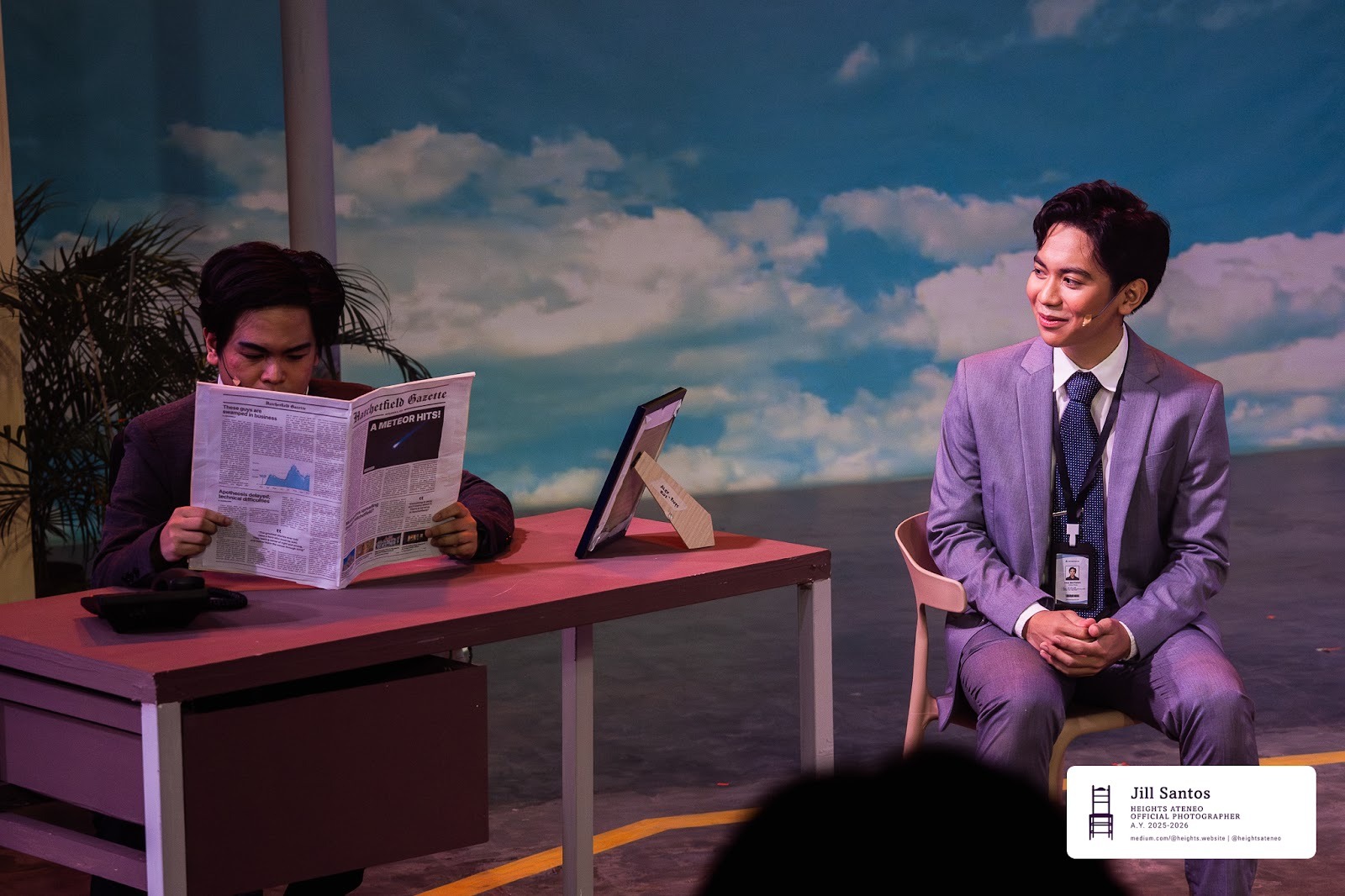
The concept of a musical about a man who does not like musicals is an innately ironic premise, but it has an underlying fearful implication. Paul Matthews, played by Kevin Maroon, watched the place he considered home lose its identity to musicals. Infections began with a lewd song from Paul’s boss entitled What Do You Want Paul?, depicting erotic fantasies to coerce Paul into singing along. The number made the infection seem trivial and almost comical, much different from its true nature depicted in the suspenseful ballad, Inevitable. In this song, the quick beat and consistent belting instilled anxiety in the audience, as the gravity of the infection and Hatchetfield’s inevitable fate dawned on them.
To set the production’s overall comedic tone, Paul’s distaste for musicals was highlighted through awkward pauses and crude expressions, which earned laughs from the audience. As the infection spread in Hatchetfield, the character’s fear became more prevalent with the songs growing frightening and even violent at times. This tone shift was done seamlessly, keeping the audience on the edge of their seats as they witnessed humor turn into fear, and disbelief into concern. This progression revealed the tendency to cope with disaster using comedy, introducing one of the many aspects of the human experience highlighted by the musical.
Still human—even if the world isn’t

The cast was not shy of showcasing the lewdness, crudeness, and violence that accompanied the human experience, with or without the threat of apocalypse. Scenes such as the characters drinking after being fully aware of the apocalypse, or the depiction of Emma’s treatment as a cafe worker and the accompanying discussions on her dead sister, show how the characters find a way to cope with these changes through distracting themselves with vices, or running back to what is familiar.
By revealing intimate thoughts, attachments to previous life, and the reliance on connection during a disaster, the production masterfully subverted horror story characters’ stereotypical reactions to the apocalypse. Bill Woodward, enacted by Zalino Gutierrez, attempted to reconnect with his family in spite of the ongoing apocalypse. His and the other characters’ attachments to the familiar and to their home were never portrayed as inane or unnecessary; rather, these displays of humanity strengthened the audience-cast connection.
As opposed to presenting the characters as heroes unfazed by disaster and focused only on solutions, they show their truest desires and struggles to the audience. Be it sexual frustrations, dependence on vices, or an attachment to family, the cast retain these humane struggles even at the face of the apocalypse.
An inevitable ice-cold shock of a finale

If there is one thing that The Guy Who Didn’t Like Musicals was guilty of, it was committing one of the most shocking and jarring mood shifts in its finale. In the climactic moment of Let It Out, Paul committed the heroic act of detonating a grenade at the base of the meteor, seemingly sacrificing his own life to stop the plague and securing a happy ending for whoever survived afterward. Yet, this sacrifice is rendered moot the moment that survivor Emma Perkins, portrayed by Mary Mangubat, tries to start a new life with another identity. At that moment, she ends up encountering another batch of plague victims, led by the now-infected and somehow-alive Paul, who sings Inevitable to her, calling upon Emma to join them as she desperately tries to flee.
This ending is perhaps one of the most stunning mood whiplashes to be made: a good—if extremely bittersweet—conclusion, shattered by the very end at the hands of someone the audience has come to trust and root for. Instead of a satisfying ending where Paul’s sacrifice is not in vain and Emma gets to start a new life, the denouement comes like a bucket of cold water to the face. It renders Paul’s sacrifice in vain, dooms Emma to a fate worse than death (if not death outright), and shatters the hearts and hopes of the viewers alike.
Regardless, such an ending, though jarring, is also fitting to the spirit of the musical. It is a beautiful subversion of the tried-and-true expectations of a fulfilling and conflict-free ending, performed with such great emotion that is fluent and in line with the hopelessness of their battle fought throughout the play. Altogether, the finale is a destructive and flawless syncopation: a dissonance breaking the symphony and harmony of happy endings, done with grace and beauty, but still shocked, confused, and broke the hearts of its viewers, leaving them unsatisfied and mourning in the absence of a hopeful fate.
A grand performance worth remembering

The plot of The Guy Who Didn’t Like Musicals—rife with subversions, parallelisms, and emotional moments—combined with the vivid performances of the newbie cast, resulted in a whirlwind of a production that resonated with audiences. Eliciting moments of joy and celebration that coexist with sorrow and horror, the musical provided undeniably spot-on performances that brought the story to life. Viewers felt as though they were experiencing the same events, feeling the same emotions, and mourning the same losses. Ultimately, the play succeeded in driving home its themes—a realistic take on surviving the apocalypse, as well as the cost and worth of sacrifice and survival.
blueREP’s newbie cast certainly succeeded in subverting expectations and giving viewers emotional whiplash, leaving an audience impact that endures long after the curtains close. For a musical whose antagonist is a plague of songs that persist among its victims, the theme’s persistence perhaps is the best reflection of that: something that is remembered, for good and for bad, and for a very, very long time.
Bianca Macalalag is an AB Psychology freshman who writes to remember life as she experiences it. Often overwhelmed with how much the world has to offer, writing serves as a way for her to make sense of it all. She hopes to place her world into words and draw readers in with a sense of comfort or familiarity. By offering new perspectives and immortalizing necessary narratives, literature is her means towards understanding others and being understood.
James Satuito is a freshman from the Diplomacy and International Relations course at the Ateneo de Manila University. An avid lover of all things retro, he lives and writes by the precept that sometimes, our past is the greatest guide to our future. His work dives into the obscure and unique quirks of the past—especially in regards to history, politics, and culture—combining entertainment and education to bring old stories to life and inspire new generations to enjoy them as well.
We are calling for contributions for the next set of articles to be featured right in our next folio. Come and submit your works today!


